Use Cases
Frontend API mocking workflow
Use deterministic local routes so frontend development is not blocked by backend availability, schema drift, or unstable test environments.
Purpose
Ship frontend screens and interaction logic with reliable local API behavior.
Where this is used
- Early UI development before backend endpoints are finished.
- QA reproduction with fixed responses.
- Demo environments where live backend access is restricted.
Setup and prerequisites
- Create a local server and choose fallback strategy (`STRICT` or `FALLBACK`).
- Add at least one endpoint in `MOCK` mode for each frontend-critical route.
- Point frontend base URL to the running Mockphine server URL.
Step-by-step workflow
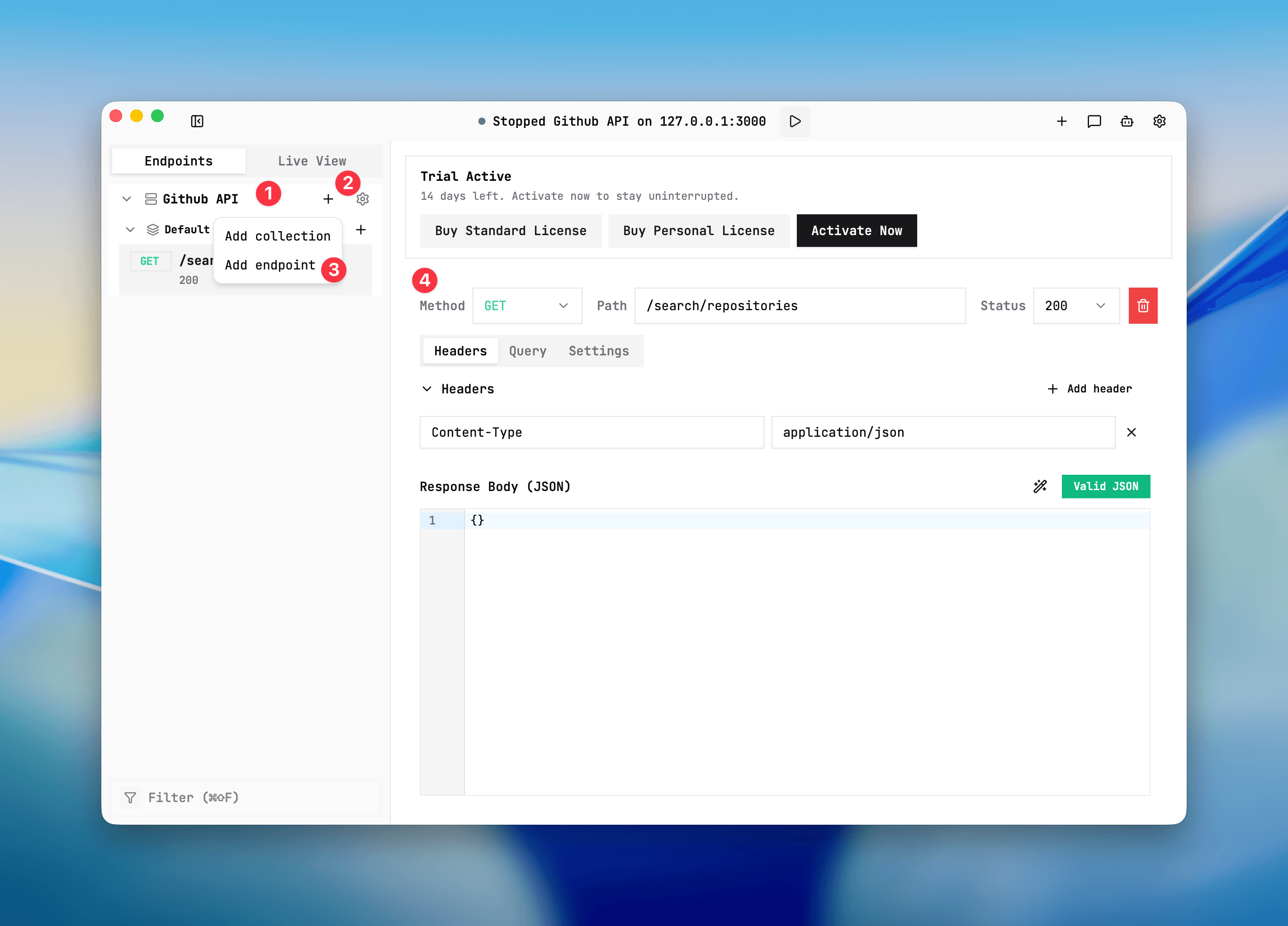
- Create a server with `STRICT` fallback to expose missing route coverage immediately.
- Add endpoints for core views (`GET` lists, `POST` create, etc.).
- Start the server and run frontend locally.
- Trigger UI flows and inspect requests in Live View.
- Patch endpoint body/status/delay settings as UI requirements change.
- When backend is ready, switch specific routes to `PASSTHROUGH` as needed.
Expected result and output
- Frontend requests resolve against predictable local responses.
- Live View shows `served-by = mock` for routes still mocked locally.
- Missing routes surface as `strict_404` when fallback is `STRICT`.
Common issues and fixes
- Frontend still hits remote API: verify the app environment points to Mockphine local URL.
- Unexpected `strict_404`: add missing endpoint or adjust method/path/query mode.
- Unexpected passthrough: check endpoint mode and server fallback mode.
To tune matching details, continue withRequest matching and routing.
Frontend mocking flow
Screenshot placeholder
Placeholder: local frontend app requests served by mocked routes in Live View.